
As a senior SEO specialist with over a decade of hands-on experience optimizing everything from small local businesses to enterprise-level e-commerce platforms at Tendify.IO, I’ve seen one truth hold steady through every algorithm shift, including the major core updates of 2025 and 2026: user intent is the only metric that truly matters.
Search engines like Google have evolved dramatically. They no longer reward keyword-stuffed pages or manipulative link schemes. Instead, they prioritize content that perfectly aligns with why a user typed their query in the first place. Master user intent (also called search intent), and you’ll unlock higher rankings, better engagement, lower bounce rates, and meaningful conversions. Ignore it, and even the best technical SEO and backlink profiles won’t save your visibility.
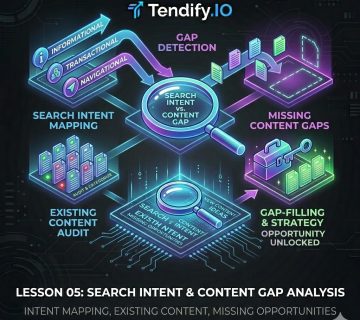
In this lesson, we’ll dive deep into the core types of user intent—informational, navigational, and transactional—while addressing closely related variations like commercial investigation (often called commercial intent). We’ll explore how to identify intent accurately in 2026, practical techniques to match it with your content, real-world examples, and advanced strategies for dominating SERPs in an AI-influenced search landscape.
Why User Intent Has Become the Single Most Important Factor in Modern SEO
Before we break down the types, let’s understand the bigger picture. Google’s Helpful Content System, reinforced through multiple 2025–2026 core updates, explicitly rewards pages that demonstrate E-E-A-T (Experience, Expertise, Authoritativeness, Trustworthiness) while satisfying the searcher’s underlying need. Search intent alignment is the foundation of that satisfaction.
Data from industry studies consistently shows informational queries dominate (~70% of searches), but transactional and commercial queries drive the majority of revenue for most businesses. Misaligning content with intent leads to poor user signals—high bounce rates, low time-on-page, minimal interactions—which Google interprets as low quality, triggering ranking demotions.
In 2026, with generative AI features in Google Search (like AI Overviews) and competing tools reshaping zero-click behavior, intent matching has become even more nuanced. Users expect instant, precise answers tailored to their exact stage in the journey. Content that anticipates follow-up needs, provides depth without fluff, and delivers value upfront wins.
The Core Types of Search Intent
While classifications vary slightly (some sources list four, five, or even six types with the rise of generative AI intent), the most practical and widely accepted framework for SEO professionals in 2026 revolves around these primary categories:
- Informational Intent Users want to learn, understand, or solve a problem. Queries often start with who, what, why, how, when, or include terms like “guide,” “tutorial,” “definition,” “best ways to,” or questions.This intent dominates the awareness stage of the customer journey. People here aren’t ready to buy—they’re gathering knowledge to make informed decisions later. Your goal is to educate comprehensively, build trust, and position your brand as an authority.Examples of informational queries:
- “What is Core Web Vitals?”
- “How does SEO work in 2026”
- “Best SEO tools for beginners”
- “Why did Google update its algorithm in December 2025?”
- Analyze SERP features: Featured snippets, “People also ask,” knowledge panels indicate strong informational dominance.
- Optimize for passage ranking: Structure content with semantic subheadings so Google can pull exact answers.
- Add unique insights: Draw from real case studies or proprietary data to differentiate from generic results.
- Navigational Intent Users already know the destination—they’re searching for a specific website, page, brand, or resource. These queries are brand-specific or URL-like.Examples:
- “Tendify.IO login”
- “Facebook”
- “YouTube”
- “Google Search Console”
- Consistent NAP (Name, Address, Phone) across directories
- Clear site architecture and internal linking
- Verifying Google Business Profile and Knowledge Graph entities
- Securing exact-match branded searches through consistent online presence
- Transactional Intent Users are ready to take action—buy, sign up, download, book, or subscribe. These queries include modifiers like “buy,” “order,” “price,” “near me,” “discount,” “best 2026,” or specific product names + “review” with purchase signals.Examples:
- “Buy noise-cancelling headphones online”
- “SEO services pricing Tendify.IO”
- “Best CRM software free trial”
- “Book flight to Paris”
- Use long-tail transactional keywords with high commercial value
- Implement dynamic pricing and stock indicators
- Reduce friction: one-click options, guest checkout
- Track micro-conversions to refine intent matching
Note on Commercial Investigation (Commercial Intent) Many experts treat commercial (or commercial investigation) as a distinct fourth type, bridging informational and transactional. Users know they want to buy but are comparing options, reading reviews, or seeking “best [category]” lists.
Examples:
- “Best SEO agency 2026”
- “Top Android smartphones comparison”
- “Semrush vs Ahrefs”
- “Cheap laptops for students reviews”
Content for commercial intent includes comparison tables, pros/cons lists, “vs” articles, buyer guides, and review roundups. Include affiliate links, star ratings, and authentic user experiences.
In practice, many keywords blend intents (e.g., “best ” can be commercial with transactional undertones). Always check the SERP to see dominant formats.
How to Accurately Identify User Intent in 2026 (Step-by-Step Best Practices)
- Perform Manual SERP Analysis (most reliable method) Search the target keyword in incognito mode. Examine:
- Top 10 results: What format dominates (guides, product pages, reviews, brand homepages)?
- SERP features: Featured snippets = informational; shopping results = transactional; local pack = local/transactional
- AI Overviews/SGE elements: What questions do they answer?
- “People also ask” and related searches: Reveal intent clusters
- Use Keyword Research Tools Tools like Semrush, Ahrefs, or Google Keyword Planner now label intent (I = informational, N = navigational, C = commercial, T = transactional). Cross-reference with SERP analysis.
- Analyze Query Modifiers
- Informational: what, how, why, guide, tutorial, vs (sometimes)
- Navigational: brand names, login, official
- Commercial: best, top, comparison, review, vs
- Transactional: buy, price, order, cheap, near me, coupon
- Leverage User Behavior Signals Use Google Search Console to see which pages rank for which queries, then map click-through rates and impressions to intent.
- Incorporate AI and Generative Trends With generative intent rising (queries like “generate a blog post about SEO”), monitor how users shift between traditional Google and AI tools. Create content that works across both.
Advanced Strategies: Matching and Exceeding User Intent
- Create Intent-Based Content Clusters Build pillar pages (broad informational) linking to cluster content (specific commercial/transactional).
- Use Zero-Click Defenses In AI-heavy SERPs, provide unique angles, data, or experiences that AI can’t replicate easily.
- Monitor and Adapt to Algorithm Shifts Post-2025 updates emphasize real-world helpfulness. Regularly audit content for intent drift.
- Combine Intents on Multi-Purpose Pages Strong pages often satisfy primary intent while addressing secondary ones (e.g., a product page with detailed informational sections).
Final Thoughts on Mastering User Intent
User intent isn’t a checkbox—it’s the heartbeat of every successful SEO campaign. When you consistently deliver exactly what searchers need at the moment they need it, rankings, traffic, and conversions follow naturally.
At Tendify.IO, we’ve transformed struggling sites into revenue machines by ruthlessly aligning every piece of content to intent. Start applying these principles today: pick 5–10 keywords, analyze their true intent, and audit your existing pages. The improvements will compound quickly.
Ready to go deeper? Continue with the next lessons in our 30-lesson SEO Mastery series at Tendify.IO. Lesson 3 SEO Success Metrics & KPIs—don’t miss it if you want to turn insights into real rankings.
Keep optimizing smartly, Your Senior SEO Expert at Tendify.IO


No comment