
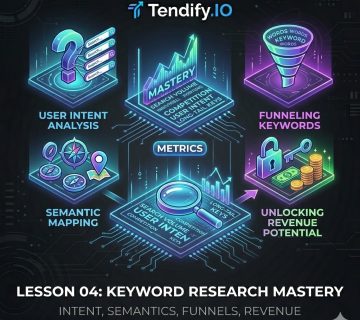
As a senior SEO specialist with more than a decade of hands-on experience scaling websites for global brands and ambitious startups at Tendify.IO, I can confidently say that keyword lists alone are meaningless without deep alignment to search intent. In 2026, where Google’s AI Overviews dominate informational queries, zero-click searches are the norm, and generative AI reshapes discovery, understanding why users search—and delivering exactly what they need—has become the single most decisive factor in ranking, visibility, and conversions. Search intent mastery turns a generic keyword strategy into a precision-engineered content machine that captures traffic at every stage of the buyer’s journey.
This lesson equips you with battle-tested frameworks for mapping keywords to user intent, conducting thorough content gap analysis against competitors, and ensuring your site covers the full spectrum from top-of-funnel awareness to bottom-of-funnel decision-making. We’ll leverage tools like Ahrefs, SEMrush, and Google Search Console to uncover hidden opportunities, prioritize high-impact gaps, and build topical clusters that signal undeniable expertise to both traditional algorithms and AI systems. By the end, you’ll know exactly how to transform competitor strengths into your own roadmap for organic dominance in an AI-first search landscape.
The Evolution of Search Intent in 2026: Why It Matters More Than Ever
Search intent—the genuine reason behind a query—has always been important, but in 2026 it reigns supreme. Traditional classifications included four core types: informational (seeking knowledge, e.g., “what is search intent”), navigational (finding a specific site, e.g., “Tendify.IO login”), commercial investigation (researching options, e.g., “best SEO tools 2026 comparison”), and transactional (ready to act, e.g., “buy Ahrefs subscription”). These remain foundational, but AI-driven changes have introduced nuances and even entirely new behaviors.
Google’s AI Overviews, powered by advanced models like Gemini 3, now appear on the vast majority of informational and many commercial queries, synthesizing answers directly in the SERP. This leads to sharp declines in organic click-through rates—often 50-60%+ for queries triggering overviews—pushing zero-click searches into the mainstream. Users increasingly expect immediate, conversational answers rather than lists of links. Meanwhile, generative platforms (ChatGPT, Perplexity, Gemini) handle exploratory, multi-step queries where intent evolves mid-conversation.
Emerging patterns show a shift toward exploratory intent (broad discovery without clear goals), task-oriented intent (AI agents completing actions), and generative intent (queries designed for AI summarization). For SEO professionals, this means content must not only match intent but provide unique value—depth, originality, E-E-A-T signals, and structured data—that AI models cite or that compels users to click through for more.
Ignoring intent alignment is fatal: even perfectly optimized pages fail if they mismatch what the user (or AI) expects. High-performing sites in 2026 map every keyword to a specific intent type, buyer’s journey stage, and content format, creating seamless experiences that retain users and earn citations in AI responses.
Mapping Keywords to the Buyer’s Journey: Awareness, Consideration, Decision
The classic buyer’s journey—Awareness (problem recognition), Consideration (evaluating solutions), Decision (choosing and purchasing)—remains highly relevant for structuring content in 2026, especially for B2B and high-consideration purchases. AI hasn’t eliminated the journey; it has accelerated and fragmented it, with users bouncing between search, social proof, AI assistants, and direct site visits.
- Awareness / Top-of-Funnel (TOFU): Users realize a problem or need but lack solutions. Queries are broad and informational: “why is my website traffic dropping,” “SEO trends 2026.” Content here educates without selling—long-form guides, infographics, videos, FAQs. Goal: attract wide audiences, build brand recall, capture early-stage traffic before competitors. In AI era, TOFU content must be exceptionally comprehensive to appear in overviews or avoid full summarization.
- Consideration / Middle-of-Funnel (MOFU): Users research options and compare. Commercial investigation dominates: “Ahrefs vs SEMrush 2026,” “best keyword research tools for agencies.” Formats include comparisons, case studies, buyer’s guides, webinars. Goal: position your brand as the authoritative choice, nurture leads, drive qualified traffic. These queries often trigger partial AI summaries, so include unique data, original research, or tools that encourage deeper engagement.
- Decision / Bottom-of-Funnel (BOFU): Users are ready to convert. Transactional queries rule: “Tendify.IO SEO services pricing,” “hire SEO expert near me.” Content focuses on product pages, pricing tables, demos, testimonials, free trials. Goal: remove friction, maximize conversions. BOFU pages benefit most from traditional ranking as AI less frequently fully answers purchase-ready queries.
Best practice: Create a content map spreadsheet with columns for keyword, monthly volume, intent type, journey stage, current ranking (if any), competitor coverage, and planned content type. Aim for balanced coverage—roughly 50% TOFU for traffic volume, 30% MOFU for authority building, 20% BOFU for revenue. This ensures you’re visible throughout the entire path to purchase.
Conducting Content Gap Analysis: Step-by-Step Process in 2026
Content gap analysis compares your site’s coverage against competitors to reveal missing topics, under-optimized pages, and untapped keyword opportunities. In 2026, it extends beyond traditional SEO to include AI visibility gaps—where competitors get cited in overviews while you don’t.
Step 1: Identify 4-6 True Competitors Select sites ranking consistently for your target keywords (use Ahrefs/SEMrush Organic Research). Include direct rivals, fast-growing challengers, and authority publishers in your niche. Avoid vanity—focus on domains stealing your traffic.
Step 2: Run Keyword Gap Reports In SEMrush Keyword Gap: Enter your domain + up to 4 competitors → select “Missing” or “Weak” filters. Export keywords where competitors rank in top 10-30 but you rank outside top 100 or not at all. Filter by intent, volume (>200), KD (<50 for quicker wins), and business relevance.
In Ahrefs Content Gap: Input your domain + up to 9 competitors → view “Keywords” where others rank top 100 but you don’t. Use traffic potential, parent topic clustering, and “Best by links” to prioritize.
Step 3: Layer Intent and Journey Mapping Categorize exported keywords by intent and stage. Group by parent topics (e.g., all “SEO course” variations under one pillar). Identify clusters where you lack coverage—e.g., competitors dominate MOFU comparisons while you only have TOFU guides.
Step 4: Audit AI Visibility Gaps Use SEMrush AI Visibility Toolkit or manual checks: Search key queries in Google → note if AI Overviews cite competitors. Tools like Perplexity or Gemini can reveal citation patterns. Look for “information gain” opportunities—unique angles, data, or formats competitors miss.
Step 5: Prioritize and Plan Score gaps using: (Search Volume × Intent Strength × Conversion Potential) / Difficulty + AI Citation Likelihood. Prioritize high-value, low-competition clusters first. Plan pillar-cluster architecture: one comprehensive pillar page per major topic, supported by 8-15 cluster articles targeting specific long-tail intents.
Step 6: Execute and Monitor Create or update content with intent-first outlines (answer primary query in first 200 words, expand with depth). Track in Google Search Console for impressions/clicks, Ahrefs/SEMrush for ranking changes, and AI tools for citation wins. Refresh quarterly as AI behaviors evolve.
Advanced Techniques: Topical Authority, E-E-A-T, and AI Optimization
Build topical authority by covering subtopics exhaustively—Google and AI reward depth. Use schema markup for entities, FAQs, and how-tos to enhance AI parsing. Demonstrate E-E-A-T (Experience, Expertise, Authoritativeness, Trustworthiness) through author bios, original data, citations, and user-generated proof.
For AI-specific gaps, create content with “information gain”—fresh insights, proprietary research, unique visuals—that AI can’t synthesize elsewhere. This increases citation chances in overviews.
Common pitfalls: Chasing every gap (focus on 20% driving 80% impact), ignoring mobile/voice intent, or creating thin content. Always validate with real SERP analysis—what format wins?
Conclusion: Turning Intent into Unstoppable Organic Growth
Mastering search intent and content gap analysis transforms reactive SEO into proactive dominance. By aligning every piece of content to user needs across the buyer’s journey and systematically closing gaps competitors overlook, you’ll capture traffic that converts, build lasting authority, and future-proof against AI disruptions.
At Tendify.IO, we’ve used these exact frameworks to help clients triple organic revenue in under 18 months. The path is clear: understand intent deeply, audit ruthlessly, create relentlessly.
Don’t stop here—dive into the next lessons in our 30-part SEO Mastery series at Tendify.IO. From on-page optimization mastery to technical SEO deep dives and link-building strategies, each builds on the last. Your breakthrough organic growth starts with consistent learning—keep going, keep optimizing, and watch your site rise to the top!

No comment