
Level: Intermediate
Focus: Turning well-researched content into fully optimized pages that search engines love to rank and users love to engage with.
Introduction to On-Page SEO in the Modern Era
On-page SEO encompasses all the optimizations you control directly on your website’s individual pages. It bridges keyword research, user intent, and technical foundations to create pages that rank higher, convert better, and satisfy both algorithms and humans.
In 2026, on-page optimization has evolved far beyond simple keyword placement. Search engines like Google use advanced natural language processing, entity understanding, and user experience signals. Pages that align perfectly with search intent, demonstrate E-E-A-T (Experience, Expertise, Authoritativeness, Trustworthiness), and deliver exceptional usability consistently outperform competitors.
At Tendify.IO, we have seen clients achieve 2-5x traffic growth by systematically optimizing on-page elements while maintaining a user-first approach. This lesson provides a complete, actionable framework you can apply immediately.
Why On-Page SEO Remains the Foundation of Sustainable Rankings
On-page factors directly influence how search engines understand, categorize, and rank your content. Even with perfect technical SEO and strong backlinks, poorly optimized pages rarely rank well. Conversely, strong on-page optimization amplifies the impact of off-page efforts.
Key benefits include:
- Improved crawl efficiency and indexing
- Better alignment with semantic search and topical authority
- Higher click-through rates (CTR) from compelling titles and meta descriptions
- Enhanced user engagement metrics that feed into ranking algorithms
- Stronger E-E-A-T signals that build long-term trust
Search engines evaluate hundreds of on-page signals. Mastering them creates compounding advantages that compound over time.
Comprehensive On-Page SEO Checklist for 2026
Title Tags Craft unique, compelling title tags under 60 characters. Front-load primary keywords naturally while prioritizing clickability. Include power words, numbers, or questions when they match intent. Avoid keyword stuffing—focus on accuracy and appeal. Test variations with tools like Google Search Console for performance.
Meta Descriptions While not a direct ranking factor, optimized meta descriptions (150-160 characters) significantly boost CTR. Summarize the page’s value proposition, include the primary keyword, and add a clear call-to-action. Make them action-oriented and benefit-focused.
Header Tags (H1-H6) Use a single H1 tag that closely matches the target keyword and user intent. Structure subsequent headings (H2, H3) logically to create a clear content hierarchy. Headings should guide readers and help search engines understand topical structure. Incorporate semantic variations and related entities naturally.
URL Structure Keep URLs short, descriptive, and readable. Use hyphens to separate words, include the primary keyword, and avoid unnecessary parameters or dates. Clean URLs improve user experience and shareability while sending clear signals to crawlers.
Content Optimization
- Place the primary keyword naturally in the first 100 words.
- Maintain optimal content length based on intent and competition (deeper for informational topics).
- Use semantic keywords, LSI terms, and entities throughout.
- Break text with short paragraphs, bullet points, numbered lists, and tables for readability.
- Focus on scannability—most users skim before committing.
Image Optimization
- Use descriptive, keyword-rich file names (e.g., on-page-seo-checklist-2026.jpg).
- Always add relevant alt text that describes the image and supports context.
- Compress images for fast loading without quality loss.
- Consider WebP format and responsive images.
- Add structured data for images where appropriate (e.g., Product or Article schema).
Internal Linking Strategically link to other relevant pages on your site using descriptive anchor text. This distributes page authority, helps users navigate, and strengthens topical clusters. Aim for a natural, helpful internal linking structure rather than forced optimization.
Schema Markup (Structured Data) Implement relevant schema.org markup to help search engines understand content context. Common types include Article, FAQ, HowTo, Organization, and Person. Schema enhances rich results potential and supports E-E-A-T by providing explicit entity relationships.
Advanced On-Page Techniques: Semantic SEO and E-E-A-T Integration
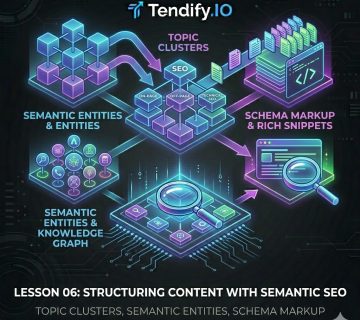
Building on Lesson 06, integrate semantic optimization deeply. Create content clusters around core topics, using related entities and attributes to build authority. Demonstrate E-E-A-T through author bios, original research, case studies, testimonials, and clear sourcing.
Practical steps:
- Add author schema with verifiable credentials and links to social profiles.
- Include original data, charts, or research findings.
- Use clear, expert-level language balanced with accessibility.
- Update content regularly with fresh insights to maintain relevance.
Page Experience and Core Web Vitals Optimization
On-page SEO now heavily incorporates user experience. Optimize for:
- Largest Contentful Paint (LCP): Ensure main content loads quickly.
- Interaction to Next Paint (INP): Minimize delays in interactivity.
- Cumulative Layout Shift (CLS): Prevent unexpected layout movements.
Techniques include lazy loading images, efficient CSS/JS, font optimization, and prioritizing above-the-fold content. Mobile-first design is non-negotiable, as Google uses mobile indexing as the primary version.
Common On-Page SEO Mistakes to Avoid
- Duplicate or thin content across pages
- Over-optimization (keyword stuffing in titles, headings, or alt text)
- Missing or generic meta tags
- Broken internal links or poor site architecture
- Ignoring mobile usability
- Neglecting freshness signals on evergreen content
- Poor readability and high bounce rates due to dense walls of text
Regular audits using tools like Screaming Frog, Sitebulb, or Semrush help catch these issues early.
Step-by-Step On-Page Optimization Process
- Analyze Current Performance — Use Google Search Console and Analytics to identify underperforming pages.
- Competitor Analysis — Study top-ranking pages for structure, depth, and features.
- Keyword & Intent Mapping — Align primary and secondary terms with user needs.
- Rewrite/Optimize Elements — Update titles, headings, content, and technical aspects.
- Enhance with Multimedia & Schema — Add value through visuals and structured data.
- Internal Linking Pass — Strengthen topical connections.
- Test & Monitor — Deploy changes and track performance over 4-8 weeks.
Tools for On-Page SEO Mastery
- Google Search Console & PageSpeed Insights
- Semrush, Ahrefs, or Moz for on-page audits
- Screaming Frog SEO Spider
- Surfer SEO or Clearscope for content optimization
- Schema markup generators
- GTmetrix or WebPageTest for performance
Measuring On-Page SEO Success
Track organic traffic, impressions vs. clicks (CTR), average position, time on page, bounce rate, and conversions. Use ranking improvements and featured snippet wins as leading indicators. Revenue and lead attribution provide the ultimate validation, aligning with Lesson 03 principles.
Practical Exercise: Select one important page on your site (or a client’s). Perform a full on-page audit using the checklist above. Implement at least 10 improvements and document results after 30 days. Share your before/after metrics in the Tendify.IO community for feedback.
This lesson builds directly on previous foundations and prepares you for deeper technical SEO in upcoming modules. On-page mastery transforms good content into high-performing assets that drive sustainable organic growth.
Conclusion from the Expert
Mastering on-page SEO is where strategy meets execution. It’s the repeatable process that turns knowledge into rankings and rankings into revenue. Commit to excellence in every element, always prioritizing the user, and you will build a site that search engines reward for years to come.
Continue your journey with the next lessons in this comprehensive SEO Mastery Course at Tendify.IO. Explore technical SEO, link building strategies, local optimization, and advanced AI-powered techniques to become a true SEO leader in your field. Your next-level results are just one optimized page away.

No comment