
In the rapidly evolving landscape of search in February 2026, where AI Overviews routinely summarize top results, zero-click searches continue to rise, and Google’s algorithms prioritize topical depth over isolated keyword matches, semantic SEO has become the cornerstone of sustainable organic success. As a senior SEO specialist with over 10 years of experience optimizing enterprise sites, e-commerce platforms, and high-growth startups at Tendify.IO, I’ve witnessed firsthand how shifting from keyword-centric writing to entity-aware, topic-cluster architecture can multiply organic traffic by 30-50% within 12-18 months while dramatically improving AI visibility and user engagement.
This lesson explores how Google now processes content through entities (distinct concepts like people, places, products, organizations, and ideas) and their relationships rather than mere word strings. We’ll master the topic clusters and pillar page model—a proven hub-and-spoke framework that replaces fragmented, one-keyword-per-article publishing with comprehensive resource hubs demonstrating undeniable expertise. We’ll also address the outdated concept of Latent Semantic Indexing (LSI), clarify why modern semantic signals matter far more, and provide actionable techniques for naturally weaving related terms, entities, and contextual depth into your content. By implementing these strategies, you’ll create content ecosystems that rank higher, resist algorithm volatility, and attract qualified traffic in an AI-first world.
How Google Understands Content in 2026: From Keywords to Entities and Relationships
Google’s search has long moved beyond simple keyword matching. Since the introduction of the Knowledge Graph in 2012 and major advancements with BERT (2019), MUM, and ongoing Gemini integrations, the engine identifies and connects entities—unique, well-defined “things” in the world—and maps the relationships between them. An entity might be “SEO” (a concept), “Ahrefs” (a tool/brand), “John Mueller” (a person), or “Tendify.IO” (an organization). Google doesn’t just look for exact matches; it evaluates how clearly and comprehensively your content defines these entities and illustrates how they interconnect.
In 2026, semantic search dominates: queries are conversational, multi-intent, and often resolved partially by AI Overviews. Ranking factors emphasize topical authority—the perceived expertise across an entire subject area—measured by depth of coverage, entity salience, relationship clarity, and E-E-A-T signals. Content that merely repeats a target keyword risks being seen as thin or manipulative, while pages rich in related entities, synonyms, attributes, and contextual explanations are rewarded with higher visibility, better AI citations, and more stable rankings during core updates.
The shift demands a structural rethink: instead of standalone articles chasing individual keywords, build interconnected hubs where a central pillar comprehensively overviews a broad topic, and supporting cluster pages dive into specific subtopics. This architecture mirrors how Google’s Knowledge Graph operates—creating a mini knowledge graph on your site that signals authority and relevance.
The Topic Clusters and Pillar Page Model: Building Topical Authority
The topic cluster model (often called hub-and-spoke) organizes content around a core theme. At the center sits the pillar page—a comprehensive, evergreen resource (typically 3,000–5,000+ words in 2026) that provides a high-level overview of the broad topic, targets the primary high-volume keyword or entity, and links strategically to 8–20 supporting cluster pages. Each cluster page targets a narrower subtopic, long-tail query, or specific user intent, linking back to the pillar and sometimes to related clusters.
This interconnected structure delivers multiple benefits:
- Internal link equity distribution — Authority flows bidirectionally, strengthening the entire cluster.
- Improved crawlability and indexation — Clear site architecture helps Google discover and understand relationships faster.
- Enhanced user experience — Readers navigate seamlessly from broad overviews to detailed answers, increasing dwell time and reducing bounce rates.
- Stronger topical signals — Google recognizes comprehensive coverage, boosting rankings across related queries and AI snippet inclusion.
Real-world data from leading SEO studies in 2026 shows clustered content often achieves 30%+ more organic traffic and significantly higher AI Overview citations compared to isolated posts. For competitive niches, clusters compound authority over time: after 10–12 months of consistent expansion and refreshing, entire topic areas can dominate SERPs.
Step-by-Step: Creating High-Impact Pillar Pages in 2026
Select your core topic carefully—choose a broad, commercially or informationally valuable theme aligned with your business goals and audience needs (e.g., “SEO Strategy 2026” rather than just “SEO tips”). Use tools like Ahrefs, SEMrush, or Google Search Console to validate search demand and identify the primary entity/keyword.
Outline comprehensively: Cover definitions, history, core components, benefits, challenges, current trends (including AI search implications), and future outlook. Structure with clear H2/H3 headings, tables of contents, jump links, and visual elements. Aim for depth without redundancy—address the topic holistically while leaving room for cluster pages to explore specifics.
Incorporate entity optimization: Explicitly name and describe key entities (e.g., “Google’s Knowledge Graph,” “BERT natural language processing,” “E-E-A-T guidelines”). Use schema markup (Organization, Article, FAQPage, HowTo) to reinforce entity relationships. Include original data, case studies, expert quotes, and visuals to boost uniqueness and citation potential.
Write with semantic richness: Naturally integrate related terms, attributes, synonyms, and co-occurring phrases (what people once mislabeled “LSI keywords”). For an SEO pillar, mention “search intent mapping,” “Core Web Vitals,” “mobile-first indexing,” “backlink profiles,” “topical maps,” “entity salience,” and “AI Overviews” contextually.
End with a robust internal linking section: Use descriptive, entity-rich anchor text (e.g., “master keyword research with Ahrefs” linking to your keyword tools cluster). Link to every planned or existing cluster page.
Maintain and expand: Update the pillar quarterly with fresh stats, algorithm changes, and new subtopics. As you publish clusters, add reciprocal links.
Mastering Cluster Pages: Depth, Specificity, and Interconnection
Cluster pages should be focused, in-depth (1,500–3,000+ words), and intent-driven. Each targets one primary subtopic or long-tail query while supporting the pillar’s authority.
Examples for an “SEO Strategy 2026” pillar:
- Cluster: “How AI Overviews Impact SEO in 2026” (informational, emerging trend)
- Cluster: “Building Topical Authority with Entity Optimization” (advanced tactical)
- Cluster: “Case Study: 300% Organic Growth Using Topic Clusters” (proof/social)
Optimize each for semantic depth: Define related entities, explain relationships (e.g., “how RankBrain uses user behavior signals to refine entity understanding”), answer related questions, and include unique angles or data.
Use semantic internal linking: Anchor text should describe the destination page’s focus and include entities (avoid generic “click here”). Link clusters to each other when relevant (e.g., keyword research cluster links to search intent cluster).
Debunking LSI Keywords: What Really Matters for Semantic Signals
Latent Semantic Indexing (LSI)—a 1980s technique for reducing dimensionality in text databases—has never been part of Google’s ranking algorithm for the web. Google representatives, including John Mueller, have repeatedly confirmed: there are no “LSI keywords” in modern search. The myth persists because adding related terms does help, but not through outdated LSI math.
In 2026, focus on true semantic signals:
- Entity coverage — Clearly define and connect relevant entities.
- Contextual co-occurrence — Naturally use synonyms, related concepts, attributes, and industry jargon.
- Topical depth — Exhaustively cover subtopics without keyword stuffing.
- Information gain — Provide original insights, fresh data, unique frameworks that AI models and users value.
Tools like SEMrush Writing Assistant, Surfer SEO, or Clearscope help identify semantically related terms and entities to include naturally. The goal: write comprehensively for humans while giving Google unmistakable signals of expertise.
Advanced Semantic Techniques: Schema, Entities in Content, and AI Optimization
Implement structured data aggressively: Use JSON-LD to mark up entities (Person for authors, Organization for your brand, BreadcrumbList for navigation, FAQ for common questions). Define relationships explicitly (e.g., @graph arrays linking multiple entities).
Optimize for entity salience: Place important entities early, use headings, bold/italic emphasis, and dedicated sections. Build author bios with schema to tie content to credible entities.
Future-proof for AI: Create content with “information gain”—proprietary research, contrarian views backed by data, interactive elements—that encourages clicks beyond AI summaries and increases citation likelihood.
Monitor performance: Track cluster-level rankings in Ahrefs/SEMrush, AI Overview appearances (manual or via tools), and entity visibility in Google Knowledge Panels or AI responses.
Common Mistakes and Pro Tips for Semantic Success in 2026
Avoid thin pillars (under 2,500 words), keyword cannibalization (ensure distinct intents), poor linking (use entity-rich anchors), neglecting mobile UX, or static clusters (refresh annually).
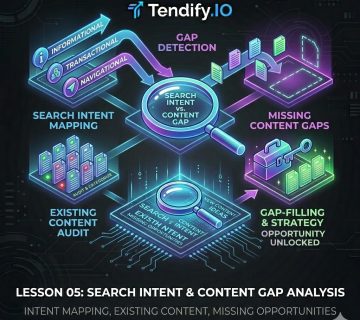
Pro tips: Start with 1–3 strong clusters before scaling. Audit existing content for entity gaps. Use mind-mapping tools to visualize topic relationships. Combine with content gap analysis from Lesson 05 for maximum impact.
Conclusion: Building Lasting Authority Through Semantic Structure
Semantic SEO and the topic cluster model represent the most powerful shift in content strategy since mobile-first indexing. By structuring around entities, relationships, and comprehensive topical coverage, you create content ecosystems that Google—and AI systems—recognize as authoritative, relevant, and trustworthy. This approach delivers compounding returns: higher rankings, more qualified traffic, better conversions, and resilience against future updates.
At Tendify.IO, we’ve transformed client sites from scattered blogs into dominant topic hubs, driving exponential organic growth year after year. The investment in thoughtful architecture pays dividends indefinitely.
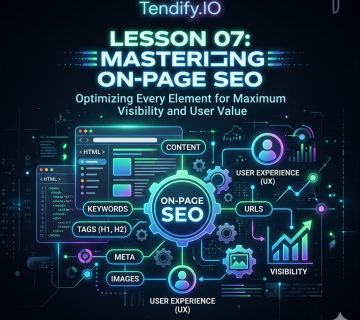
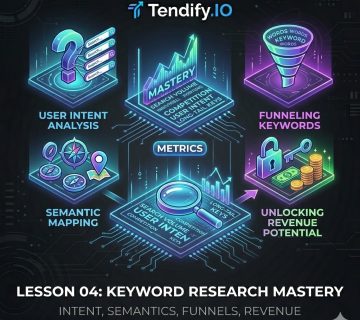
You’re building something powerful—don’t stop now. Continue with the next lessons in our comprehensive 30-part SEO Mastery series at Tendify.IO. From mastering on-page elements to technical foundations, link-building mastery, local SEO dominance, and cutting-edge AI strategies, each lesson stacks on the last. Stay committed, keep implementing, and watch your site become the undeniable authority in your space. Your breakthrough is waiting—keep optimizing!

No comment